Chaos with nothing to orbit
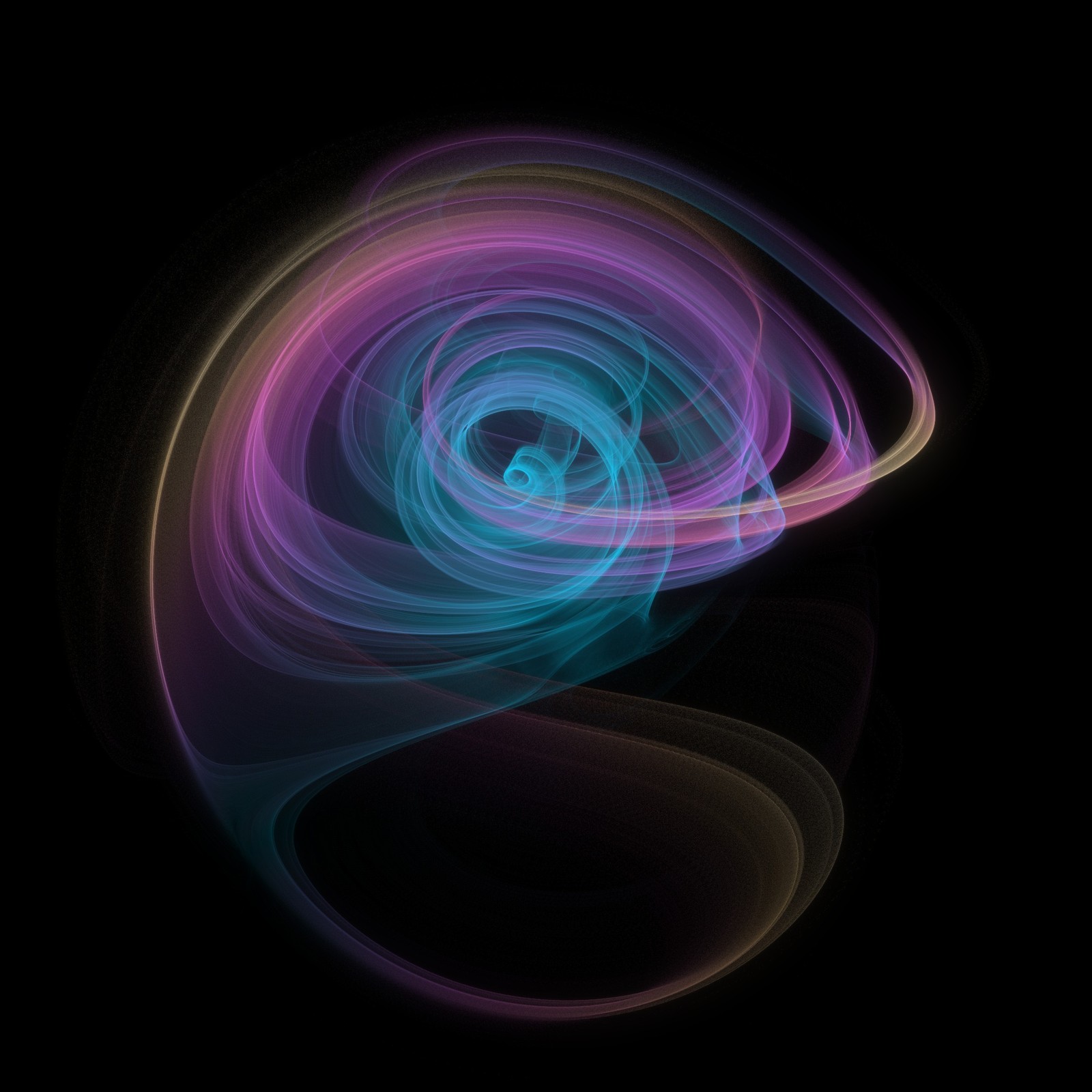
Nearly every famous chaotic system swirls around fixed points, places where the motion stops. Conch has none. It is seven terms of algebra that keep a path inside a box a few units wide forever, never settling and never repeating, with no hub to orbit. This is how a GPU search found it, how we checked it, and why it is an amateur find rather than a breakthrough.
- Found by
- GPU search of ~1.6M random quadratic flows
- Core
- 7 terms · zero equilibria (a hidden attractor)
- Checked
- 64-bit RK4 · four 100,000-unit runs · 0 escapes in 40M particles
What I found
Pruning one term at a time under a strict 64-bit test took the original 15-term system to a 7-term core, and changed its character: the original has ordinary fixed points, the core has none.
Zero equilibria, real or complex: a Gröbner basis of the fixed-point equations reduces to “1 = 0”, which makes Conch’s core a hidden attractor.
Nothing escapes: none of 40 million still-image particles left the box during warm-up, and across 20 million film particles and 480 frames the largest coordinate reached was 7.7, with no re-seeding (escape threshold 50).
λ = (0.0563, 0.0000, −0.1797) and D_KY ≈ 2.31 (2.306–2.309) against 2.322–2.325 for its closest published relative, NE16: very likely distinct, but at 7 terms not simpler than the 5–6-term no-equilibrium catalogue.
The same 64-bit audit retracted an earlier “attractor”, Tulip (all 2,048 test seeds escaped, after about 1,100 time units on average), and showed the exponents in our first field guide were 1.2–3.7× too high.
The central idea
A seven-term flow can stay bounded and chaotic with nowhere to stop; Conch is very likely a new member of a known family, which makes it a verified, pretty find, not a simpler or fundamentally new kind of system.
- 01Generate random flows
- 02Keep bounded chaos
- 03Prune term by term
- 04Prove no fixed point
- 05Compare with known systems
Contents
A shape drawn by motion
Pick a point in space and give it a rule: “wherever you are, here is the direction and speed to move next.” That rule is three short equations, one each for x, y and z. Follow the point for a long time and it traces a path. For most rules the path does something boring. It flies off to infinity, settles onto a single point, or falls into a loop that repeats forever.
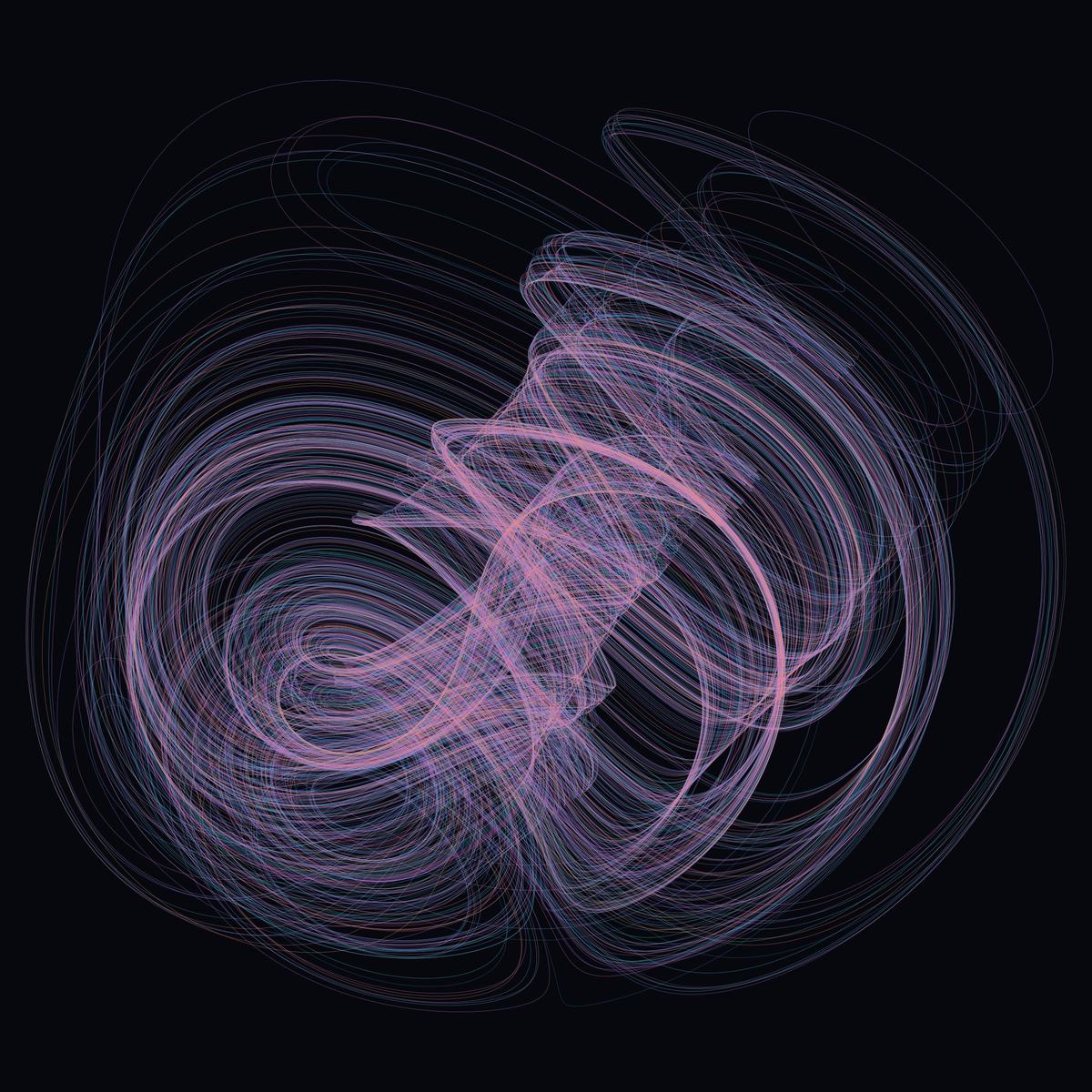
A strange attractor is the rare, interesting case. The path stays inside a finite region forever, yet it never repeats itself and never settles down. Two starting points that are almost identical drift apart until they have nothing to do with each other. That is chaos. Draw millions of points following the same rule and they settle onto a delicate, layered surface: the attractor. Every image in this note is one of those surfaces.
How the search found it
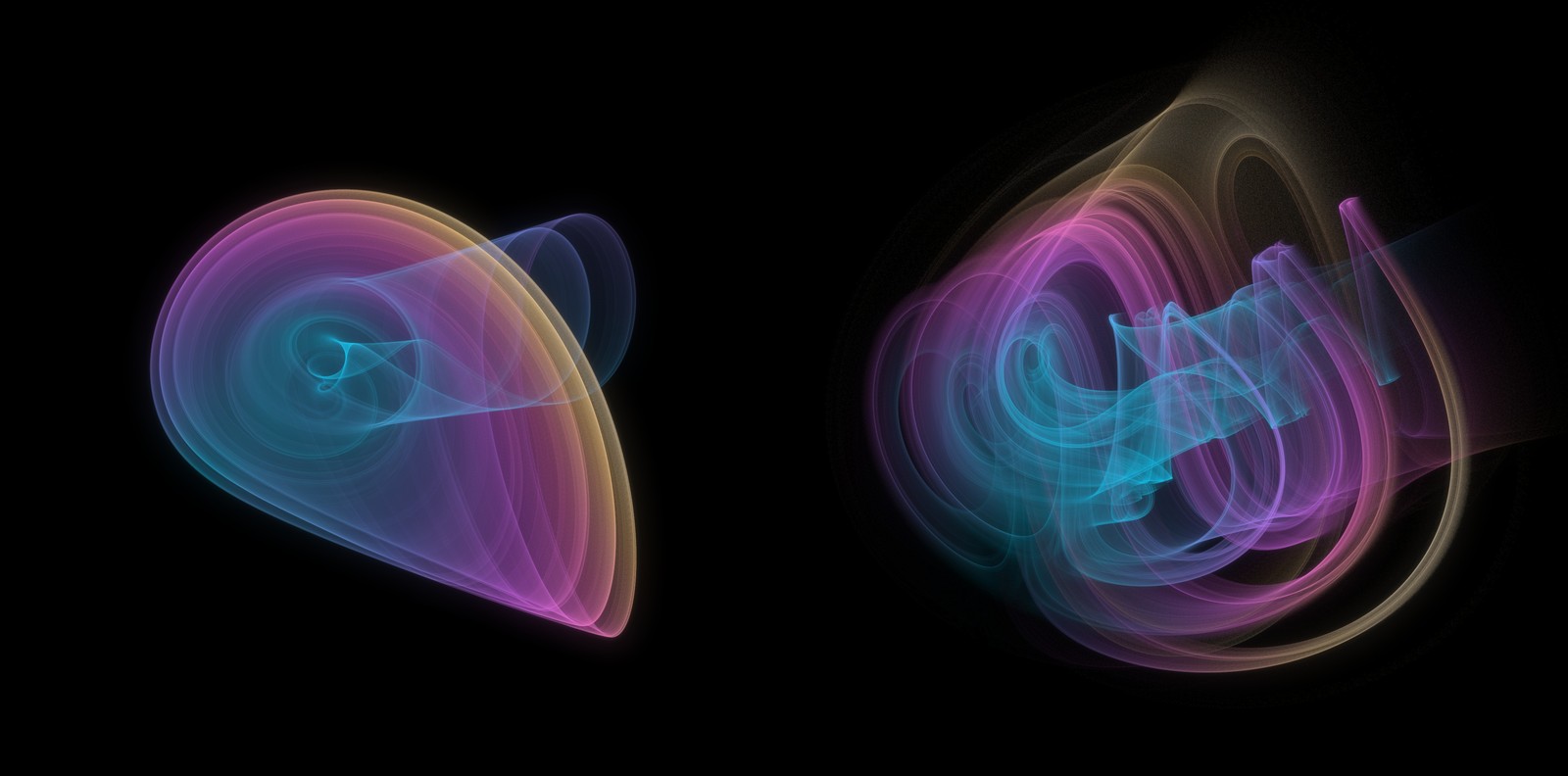
A GPU search on one workstation ran a brute-force hunt in the style the physicist J. C. Sprott pioneered in the 1990s. It generated about 1.6 million random systems of equations. Each was three equations built from the ten simplest ingredients (a constant, x, y, z and their pairwise products), with random coefficients between −1.2 and 1.2. Each system was integrated and kept only if its path stayed bounded, didn’t settle, and showed chaos: a positive Lyapunov exponent, explained below. About 0.85 percent passed. We looked through the survivors by eye and named eight. One of them looked like a spiral seashell, so it became Conch.
The original Conch had 15 terms. We then asked which of those terms actually matter. We deleted one term at a time and kept a deletion only if the system was still chaotic and bounded under a strict test of long runs at 64-bit precision. Eight terms fell away. What remains is a 7-term core, and the pruning changed its character: the original Conch has ordinary fixed points, but the core has none.
The seven terms
This is the whole thing. A dot over a letter means “rate of change in time”.
It is small enough to fit on a napkin. It’s worth noticing what isn’t there: x never feeds back on itself, and z changes only through the product xy. All of the shell’s structure comes from four quadratic terms working against each other. The initial condition we used for the core is (0.1242, −0.7840, −0.1190).
ẋ = 1.1 − 0.9·y²
ẏ = −0.8 + 0.8·y + 0.6·xy + 1.1·xz
ż = −0.8·xy
Why there is nowhere to stop
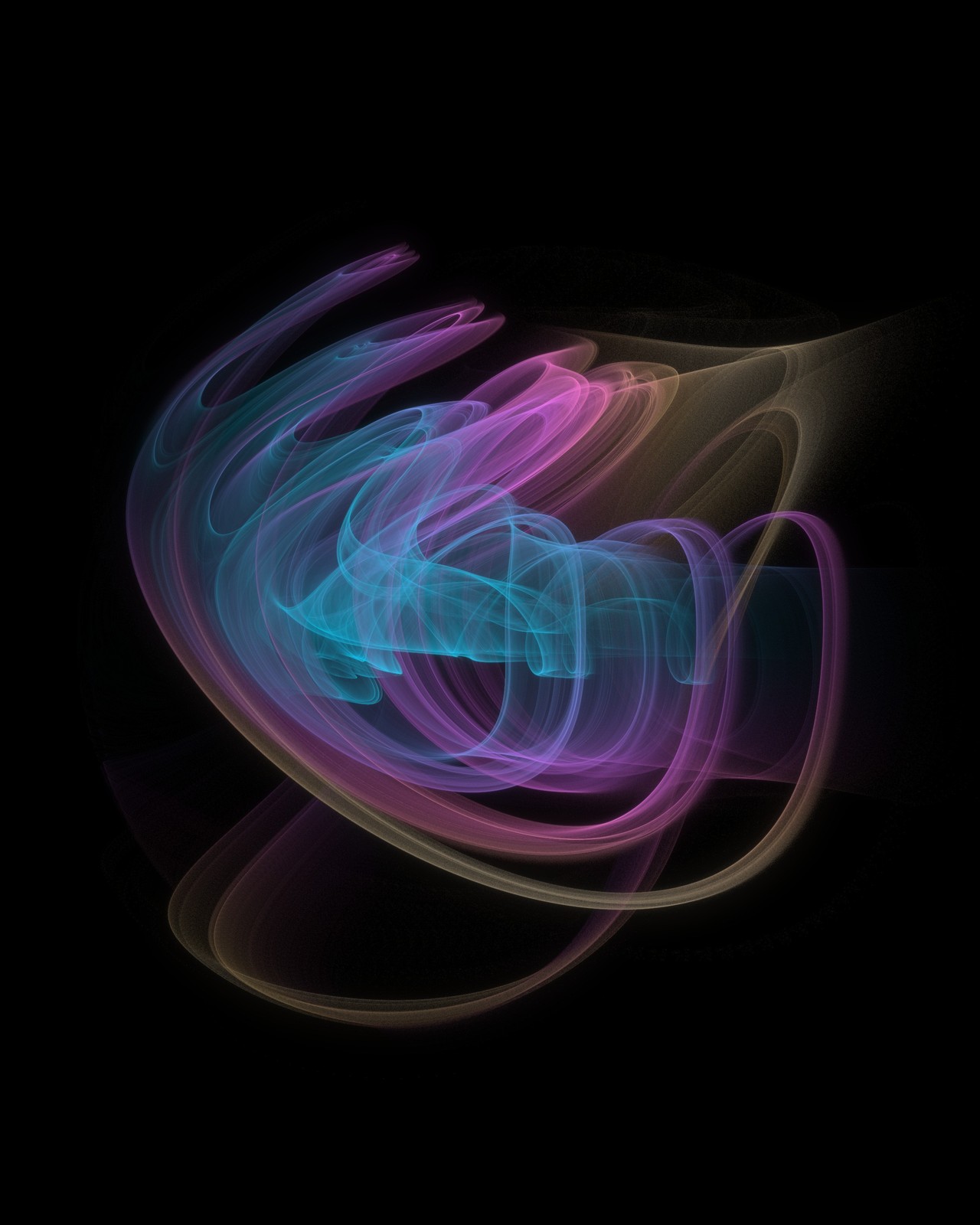
A fixed point needs all three rates to be zero at once. Here is why that can’t happen. Start with ż = 0. That means −0.8xy = 0, so either x = 0 or y = 0.
If y = 0, then ẋ = 1.1. That’s never zero, so x is always moving: no fixed point. If x = 0, then ẋ = 0 needs 0.9y² = 1.1, so y² ≈ 1.22. But ẏ becomes −0.8 + 0.8y, which is zero only when y = 1, and then y² = 1, not 1.22. The two conditions contradict each other: no fixed point.
Both cases fail, so the equations have no fixed point anywhere, not even a complex-number one. A computer-algebra check (a Gröbner basis in sympy) reduces the system to the single equation “1 = 0”, which is the algebraic way of saying “impossible”.
The numbers, checked
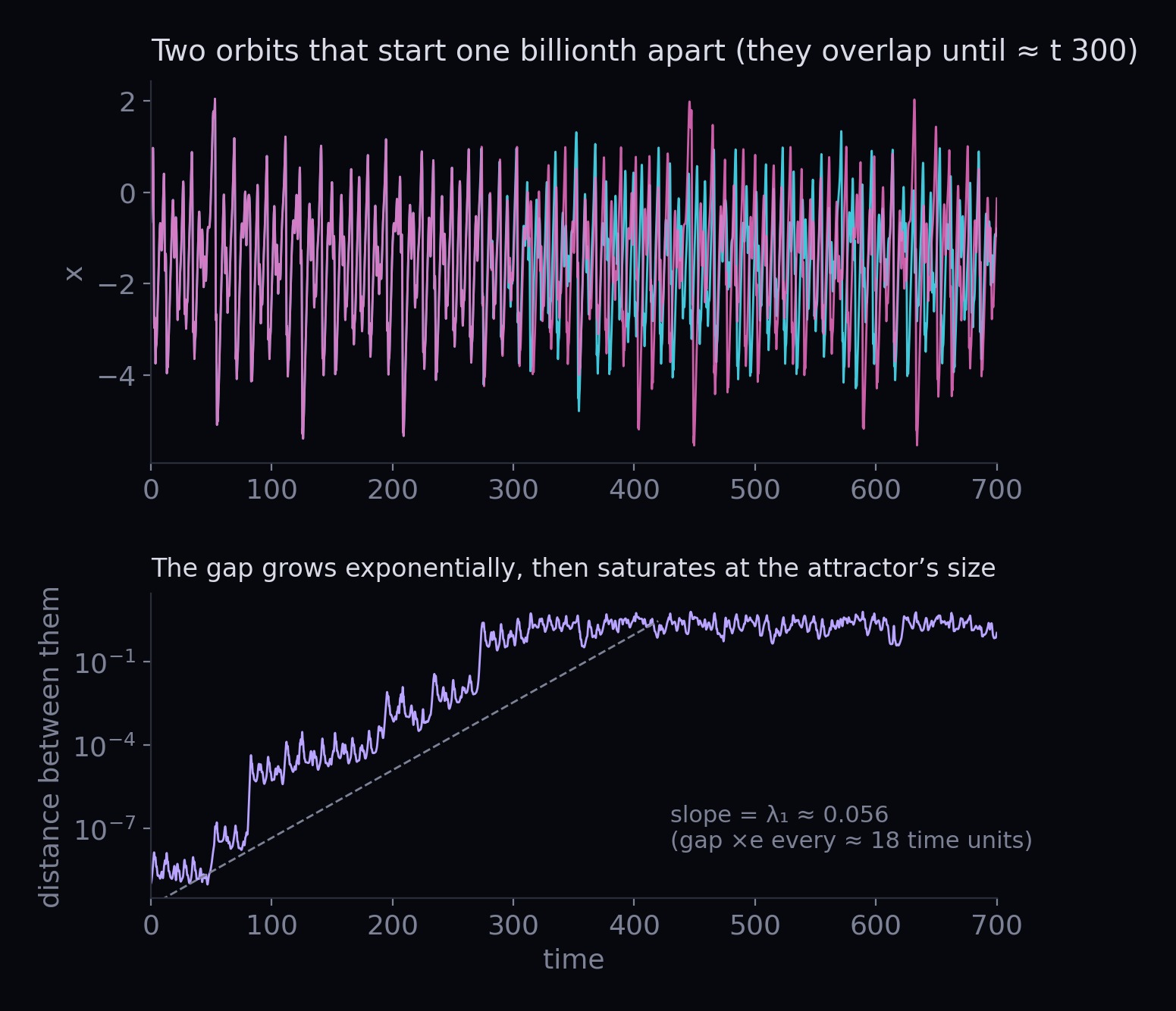
All numbers here come from 64-bit Runge–Kutta integration, run at two step sizes (h = 0.004 and 0.002) and from four starting points, for 100,000 time units each. The full spectrum is λ = (0.0563, 0.0000, −0.1797), with a spread of about ±0.0001 across the four runs.
Divergence measures how fast a small blob of starting points shrinks or grows. Here it is 0.8 + 0.6x, which depends on where you are: some regions expand and others contract. Averaged along the path it is −0.123, and that matches the sum of the three exponents (−0.123) to three digits, a standard check that the numbers are self-consistent. A quick independent two-orbit estimate gave λ₁ = 0.055–0.056.
| Quantity | Value | What it means |
|---|---|---|
| Largest Lyapunov exponent λ₁ | ≈ 0.056 | Nearby paths separate by a factor of e about every 18 time units |
| Middle exponent λ₂ | ≈ 0 | Within 10⁻⁴ of zero, as it must be for a continuous flow |
| Smallest exponent λ₃ | ≈ −0.180 | Strongly contracting direction: this folds the paths back onto the shell |
| Kaplan–Yorke dimension D_KY | ≈ 2.31 | More than a surface, much less than a solid |
| Mean divergence along the path | −0.123 | Matches λ₁ + λ₂ + λ₃ to three digits |
How honest is the integration?
Every particle in these renders was moved in 64-bit precision (RK4, step 0.005) and never re-seeded. Our older renderer quietly respawned particles that escaped. That once hid a fake attractor, Tulip, which turned out to leak to infinity: in the audit, all 2,048 test seeds escaped, after about 1,100 time units on average. The same audit found that the exponents in our first field guide, estimated at 32-bit precision over short windows, were 1.2–3.7× too high. Here nothing is respawned: escapes are only counted, and the count was zero.
None of the 40 million still-image particles escaped during their 200-unit warm-up (escape threshold: 50). In a 16-second turntable film of 20 million particles, the largest coordinate any particle reached across all 480 frames was 7.7. A single 100,000-unit path never went past 6.7. Only the drawing of the light trails uses 32-bit arithmetic, and that changes nothing about where particles go.
Is it actually new?
Probably, in a narrow sense. But it isn’t a big deal, and it’s worth being clear about why.
Hidden attractors without fixed points are a known class. In 2013 Jafari, Sprott and Golpayegani catalogued 17 of them, called NE1 to NE17. NE1 manages with 5 terms and most of the others with 6. So Conch is not the first, and at 7 terms it is not the simplest.
It does look like a different system. NE1 to NE15 have a simpler quadratic structure (rank 2 or less; Conch’s is rank 3), so no linear change of coordinates can turn one into the other. The closest relative is NE16, a 12-term symmetric system whose exponents look almost the same once you rescale time. But two measures that don’t depend on the time scale differ by more than our error bars: the dimension (2.306–2.309 against NE16’s 2.322–2.325) and the ratio λ₁/|λ₃| (0.306–0.309 against 0.322–0.325). So: very likely distinct, but a close cousin.
The field is also tired of “new chaotic systems”. Sprott’s 2011 standard asks that a new system be simpler than known ones, show new behaviour, or model something real. In a 2020 editorial titled “Do we need more chaos examples?” he argues that hidden attractors are neither rare nor hard to find. Conch meets none of the three bars.
- Jafari, Sprott & Golpayegani, “Elementary quadratic chaotic flows with no equilibria”, Phys. Lett. A (2013)
- Sprott, “Do we need more chaos examples?”, Chaos Theory and Applications (2020)
- Sprott, “A proposed standard for the publication of new chaotic systems”, Int. J. Bifurcation & Chaos (2011)
- Sprott, “Some simple chaotic flows”, Phys. Rev. E (1994)
- Sprott, Strange Attractors: Creating Patterns in Chaos (1993), free text
What we can’t claim
So this is an amateur find, not a breakthrough: a pretty, verified, probably unpublished member of a known family. It came out of a GPU search on one workstation, it survived honest checking, and it looks like a seashell. That’s a good day.
What that verdict rests on, and what it leaves out:
- Very likely distinct from NE16, by more than our error bars on two time-scale-free measures, but not simpler than the 5–6-term no-equilibrium catalogue.
- The core comes from a single greedy pruning path, so 7 is an upper bound on the fewest terms this family needs, not a proven minimum. A deeper search might find a smaller core, but it would be a different system.
- “Discovered” means found by our search. The comparison covered 89 named systems plus the 17 NE flows, not every paper ever written, so it is not proof that nobody has written Conch down before.
- Two systems can look different and still share the same underlying topology. We didn’t test that.
- The colours in the renders are an artistic encoding of speed, not an extra measurement.
Questions about this note? Get in touch.
sipratt@gmail.com